
You Left This / Geh Nicht (2024)
Aubrey Theobald, Backhaus Projects (Berlin, Germany)
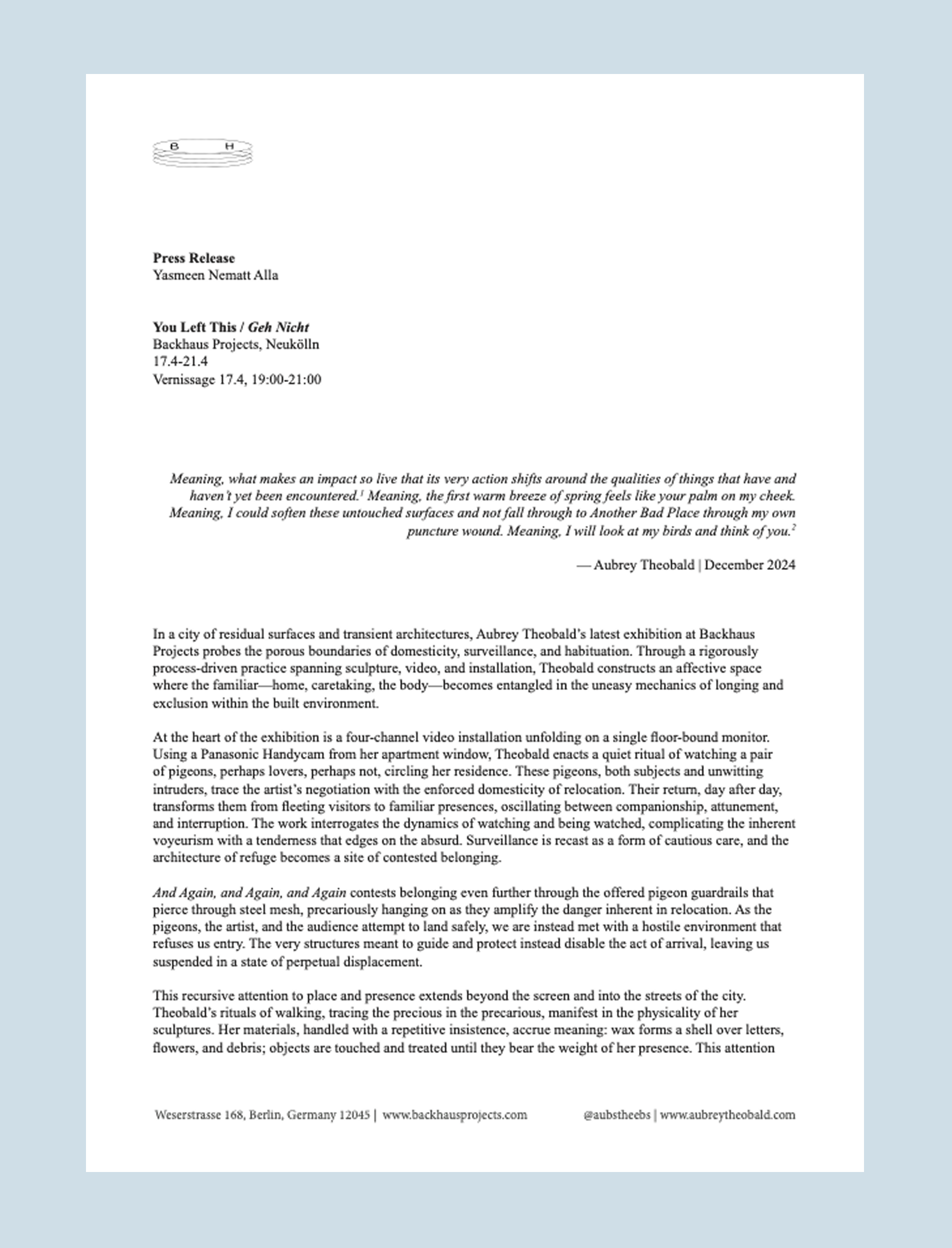
You Left This / Geh Nicht: Press Release
Meaning, what makes an impact so live that its very action shifts around the qualities of things that have and haven’t yet been encountered. Meaning, the first warm breeze of spring feels like your palm on my cheek. Meaning, I could soften these untouched surfaces and not fall through to Another Bad Place through my own puncture wound. Meaning, I will look at my birds and think of you.
— Aubrey Theobald | December 2024
In a city of residual surfaces and transient architectures, Aubrey Theobald’s latest exhibition at Backhaus Projects probes the porous boundaries of domesticity, surveillance, and habituation. Through a rigorously process-driven practice spanning sculpture, video, and installation, Theobald constructs an affective space where the familiar—home, caretaking, the body—becomes entangled in the uneasy mechanics of longing and exclusion within the built environment.
At the heart of the exhibition is a four-channel video installation unfolding on a single floor-bound monitor. Using a Panasonic Handycam from her apartment window, Theobald enacts a quiet ritual of watching a pair of pigeons, perhaps lovers, perhaps not, circling her residence. These pigeons, both subjects and unwitting intruders, trace the artist’s negotiation with the enforced domesticity of relocation. Their return, day after day, transforms them from fleeting visitors to familiar presences, oscillating between companionship, attunement, and interruption. The work interrogates the dynamics of watching and being watched, complicating the inherent voyeurism with a tenderness that edges on the absurd. Surveillance is recast as a form of cautious care, and the architecture of refuge becomes a site of contested belonging.
And Again, and Again, and Again contests belonging even further through the offered pigeon guardrails that pierce through steel mesh, precariously hanging on as they amplify the danger inherent in relocation. As the pigeons, the artist, and the audience attempt to land safely, we are instead met with a hostile environment that refuses us entry. The very structures meant to guide and protect instead disable the act of arrival, leaving us suspended in a state of perpetual displacement.
This recursive attention to place and presence extends beyond the screen and into the streets of the city. Theobald’s rituals of walking, tracing the precious in the precarious, manifest in the physicality of her sculptures. Her materials, handled with a repetitive insistence, accrue meaning: wax forms a shell over letters, flowers, and debris; objects are touched and treated until they bear the weight of her presence. This attention to a softness that crumbles, to a built structure that does not protect, holds the viewer in suspense. We become attuned to the fragility of the moment, the home, the shifting landscape, and our own precarious occupancy within it.
In Draft I Didn’t Send: Bleeding Heart Dove, a text message left unsent offers a glimpse into a private archive—a moment of disappointment, a connection withheld. Theobald grants us access to this intimate wound, a history nearly shared but ultimately retracted. These tensions resurface in Warm Palm, Cold Cheek, a piece that anchors the exhibition through a floor constructed from repurposed shelving. An object adapted to a new function, another perch now tiling the ground. If we embody the artist’s attention, we notice the debris that settles on its surface, remnants of past use and shifting purpose.
Throughout the exhibition, the specters of entrapment and adaptation haunt the material choices. Steel wire mimics the crude closures of a cage; scabbed netting accumulates the detritus of a city in flux. A bleeding dove meme is duplicated into an almost devotional icon. The hyper-sincere and the hyper-hostile converge, revealing an uneasy aesthetic of fragility and resistance—of the impulse to shelter and the inevitability of rupture. The act of nesting, both instinctual and precarious, becomes a metaphor for resilience: the ways in which belonging, love, and home are continuously sought yet never fully secured.