
How do you Know the White Tail?
Laser etched Artist Book for Taylor Knight-Turner
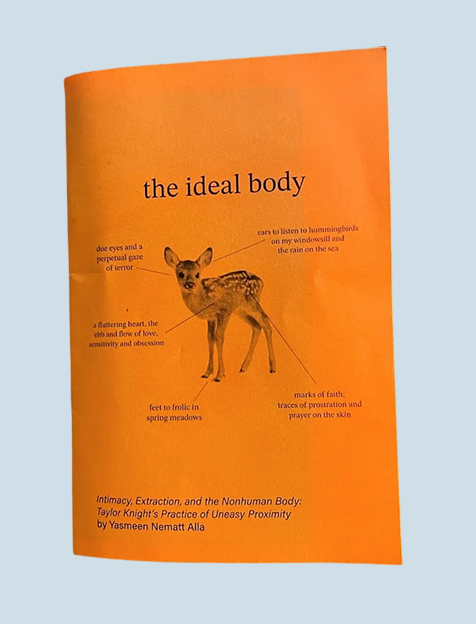
Accompanying zine for Taylor Knight-Turner’s exhibition “How Do You Know The Whitetail?,” Swords into Plowshares, Detroit, MI
How Do You Know the Whitetail? names the white-tailed deer not only as a subject but also as a site of projection, misrecognition, and instrumental knowledge. The title invites a question about how we come to know the deer: through scientific taxonomies, the scope of a rifle, roadside collisions, memes, fairytales, or field guides? Each framework reveals a different politics of relation, a way of making the deer visible, legible, and available to human systems of use. By foregrounding this question, the exhibition begins not with the deer as symbol or spectacle, but with the problem of knowledge itself: who gets to know, what counts as knowledge, and what forms of contact exist outside recognition altogether?
The work here resists the interpretive shortcuts often applied to art engaging with animal life. The nonhuman is not treated as a metaphor, symbol, or ecological signifier, but instead, its body—the deer’s—remains stubbornly present, bloody, heavy, and resistant to abstraction. This is a refusal to aestheticize the animal, to obscure the labor of touch, or to instrumentalize intimacy for emotional identification. In this refusal, the work opens up a more unsettling and urgent inquiry: what does it mean to engage with the nonhuman not as a resource, symbol, or companion—but as a body that exceeds comprehension?
The catalyst for much of this work comes from a 2021 performance in which a deer was gutted—not as a spectacle for the gallery or a rehearsed ritual of mastery, but as a durational, private act performed in the presence of a few witnesses. That the performance was never formally shown becomes significant in itself. The non-representation of the act resists systems of capture—be they anthropological, artistic, or institutional—that seek to consume the body of the animal and the labor of the artist alike. The exhibition presents not documentation or reenactment, but an ecology of aftermath: tools, images, gestures, and propositions that metabolize the unresolved tensions of the original act.
The labor of this work is not only in the act of gutting but in the ongoing engagement with its implications. Sculptures in the exhibition reproduce, at times disturbingly so, the tools of modern hunting culture—a “Butt-Out” tool, for example, which facilitates the removal of intestinal tissue during field dressing. These objects, designed to make killing more efficient, are reframed not as curiosities but as artifacts of a settler-colonial worldview where proximity to the animal is engineered, operationalized, and stripped of any reciprocal relation. The tools are neither romanticized nor condemned; they are placed within the broader epistemic frameworks that have made such forms of contact thinkable and permissible. This situates the work within posthumanist critiques of anthropocentrism, yet it resists their tendency toward abstraction or flattening of relationships.
At its core, the work is materialist, engaging directly with the meat, skin, and labor of the animal. The paintings that emerge from performance stills are not nostalgic renditions but refusals of resolution, freezing moments of discomfort and invoking the specter of documentation while insisting on opacity. The viewer is not invited into a scene of catharsis or recognition, but instead held in a space of uncertainty—a condition that the work treats not as failure but as method. The work is not about the deer; it is with the deer. In this, it asks what it means to remain accountable to an encounter that does not seek mutual understanding.
The work is not ethically neutral. It is situated within the continuing structures of settler colonialism, which regulate land, animal life, and human-nonhuman relations. Indigenous epistemologies, particularly those articulated by thinkers like Robin Wall Kimmerer, are engaged not as sources of aesthetic inspiration but as ethical correctives to dominant modes of thought. However, the work also refuses the settler fantasy of assimilation into these worldviews. Instead, it foregrounds the impossibility of innocence and the violence of unexamined intimacy. The contradiction is held without the need to resolve it.
This exhibition is not simply about deer or animality writ large. It critiques the systems that make certain forms of life touchable, killable, knowable—and others sovereign, protected, or unseen. The violence under investigation is not spectacular; it is banal, infrastructural, and intimate.
What is offered here is a practice of contact that refuses transcendence. There is no redemptive gesture, no myth of kinship to fall back on. Instead, the work engages with the difficult truth that certain forms of care have always been entangled with domination—that to touch the nonhuman body in this context is to participate in a system that extracts, categorizes, and consumes. In foregrounding this discomfort, the work asks not how we might be more ethical, but how we might be more honest about the systems in which we are already implicated.