

In Keeping House: Radicalizing the Mundane as Method for Reconciliation
An extended essay from published review and interview with Farheen HaQ in Blackflash Magazine.
01.28.2022
I. Thresholds of Care: The House as Method
I had never seen my grandmother’s home as anything other than well kept. She took pride in the way her house was always ready for her progeny. She often said that the house is a reflection of the soul and that the keeping of the house is the care you show yourself. A few years ago, when I visited her and my grandfather, who had developed dementia and only found solace in his wife, his sole caretaker, I finally noticed the strain that saturated this doctrine of care. By any ordinary standard, the house was clean. Yet objects had migrated out of place. Piles had begun to form in corners. For a moment, I was painfully aware of how much my grandmother was grieving, how precarious her own body and time had become.
This domestic scene is not an anecdotal preface but a conceptual hinge. It reveals housekeeping as both ethic and performance, a choreography of maintenance that becomes strained when grief, illness, and age accumulate. It is also a gendered and racialized labor that is seldom named as such. Feminist theorists have long argued that domestic work is both affective and material, a site where the self is produced in relation to others and where “sweaty concepts” of care, obligation, and burnout are felt most intensely (Ahmed, Living a Feminist Life). In a settler colonial context, the house is never simply private. It stands on contested ground and participates in broader structures of occupation.
The first time I encountered the work of Farheen HaQ, I was looking precisely for artists who navigated these layered questions of identity, family, and relation to land as uninvited settlers. HaQ’s work offered not representation in the narrow sense, but a method. Through modest actions and intimate spaces, she shows how practices that seem merely domestic can be re-read as spiritual, political, and territorial. In other words, housekeeping is not only the subject of her work. It is also her way of thinking.
II. Housekeeping, Domestic Labor, and Settler Complicity
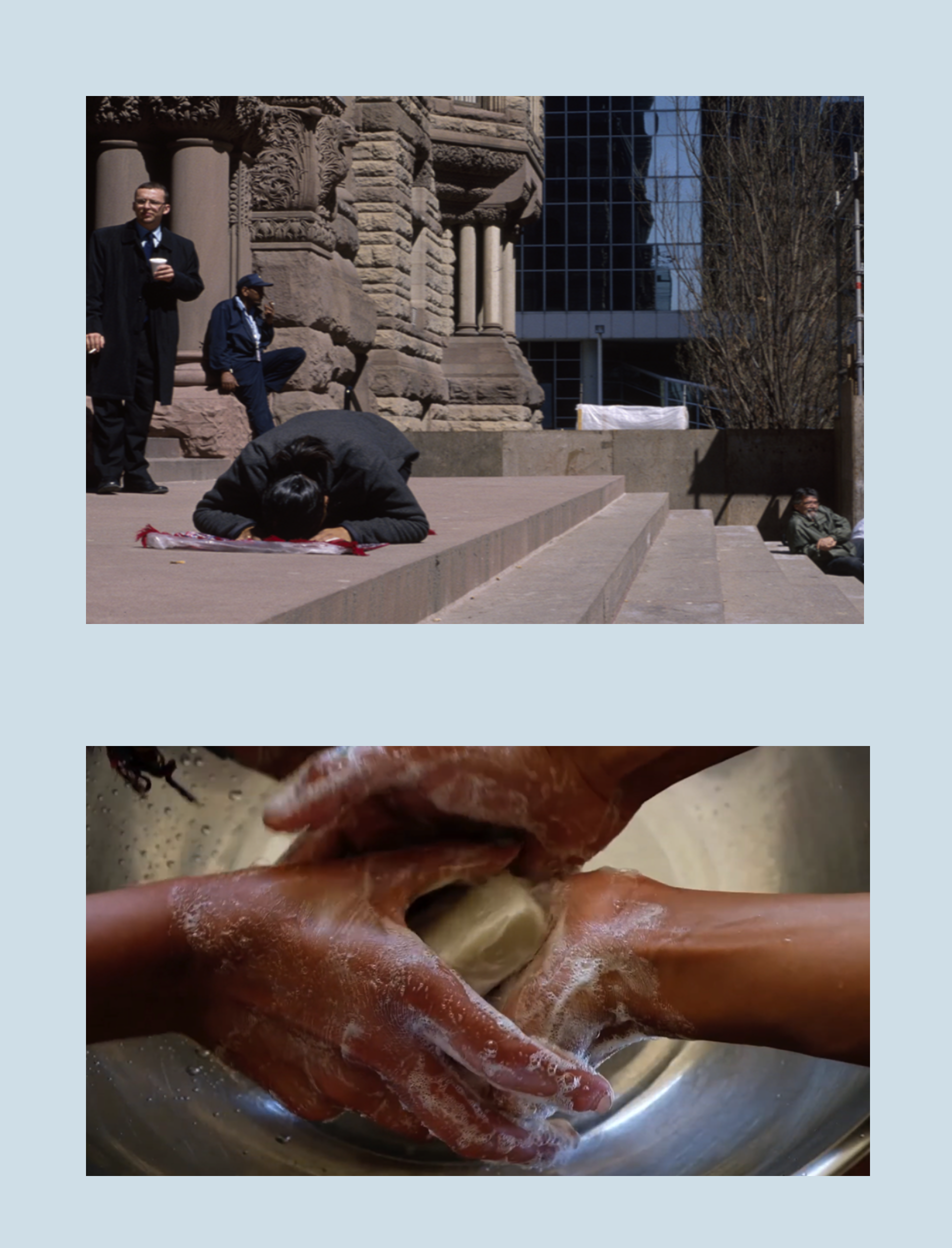
To frame HaQ’s practice as “housekeeping” is not to domesticate it, but to insist that what happens at the scale of the sink, the prayer mat, and the teacup is already implicated in the larger architectures of settler colonialism and racial capitalism. Eve Tuck and K. Wayne Yang famously caution that decolonization “brings about the repatriation of Indigenous land and life” and is “not a metaphor” for other kinds of social justice work (Tuck and Yang 1). Their warning is decisive for any reading that links household practice to reconciliation.
Housekeeping cannot stand in for material restitution of land. At most, it can register the unease of living on lands whose original caretakers have been dispossessed.
Still from Drinking from my Mother’s Saucer courtesy of Farheen HaQ
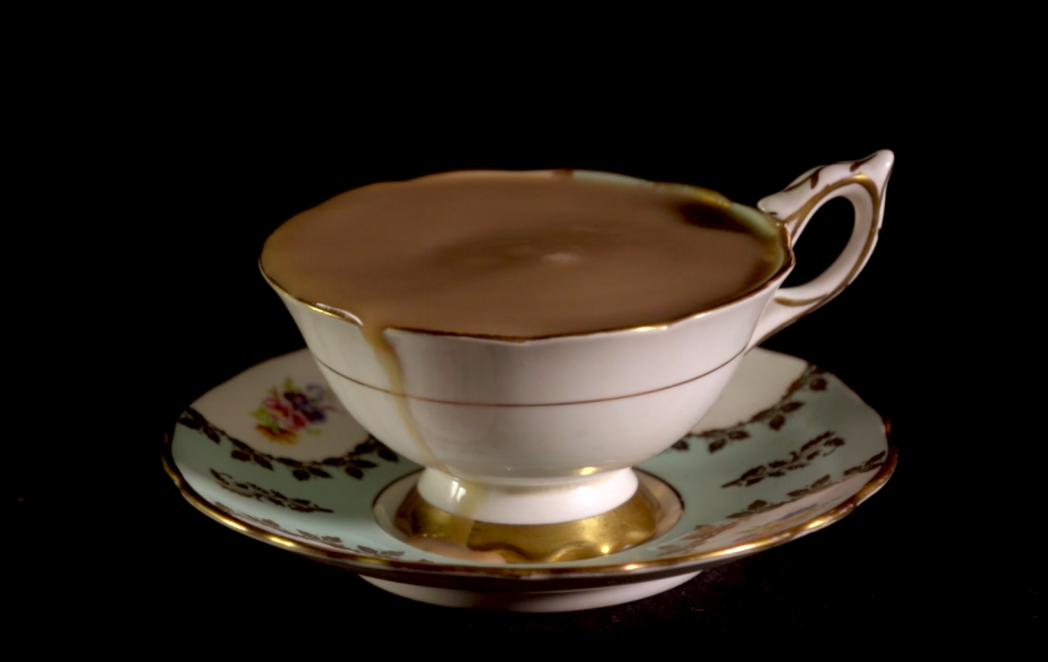
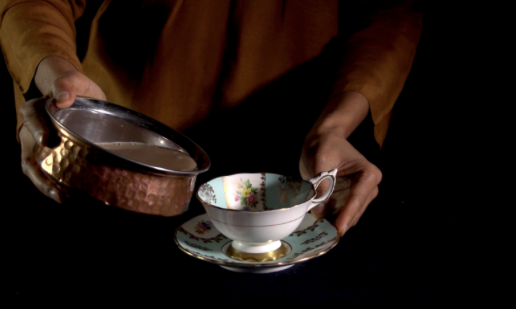
In HaQ’s work, housekeeping operates in this minor register. It is never proposed as a cure. It is an ongoing reminder that one’s everyday comforts are built on layered histories of violence. In Drinking from my Mother’s Saucer, for instance, the artist pours chai from a traditional metal vessel into a delicate bone china teacup that begins to tremble and overflow to a soundtrack of thundering buffalo hooves. The scene stages what Christina Sharpe calls “the ordinary extraordinary” of structural violence, where historical catastrophe is not an event outside the home but a constant pressure on the most banal routines (Sharpe).
“The house is a reflection of the soul” takes on a new inflection here. In settler states like Canada, houses are also reflections of title, mortgage, and property regimes that depend on the prior erasure or containment of Indigenous legal orders. Indigenous scholar Leanne Betasamosake Simpson insists that land is not a neutral backdrop but a “pedagogy,” a source of knowledge that is activated in everyday acts of relation (Simpson 1–3). If the house mirrors the soul, then the ground beneath it mirrors a much wider set of relations and broken treaties. HaQ’s attention to cleaning, praying, and serving becomes a situated practice of living with that knowledge.
At the same time, domestic space is where many diasporic families rehearse their own histories of displacement, migration, and survival. Saidiya Hartman describes the figure of the enslaved person as “a stranger torn from family, home, and country,” for whom the loss of mother and home produces an enduring condition of unbelonging (Hartman). While HaQ’s family history is shaped by Partition and South Asian migrations rather than transatlantic slavery, her work similarly recognizes how dislocation continues to reverberate at the most intimate level: in how a mother serves tea, how a daughter prays, how a house is kept or allowed to fall into disarray.
The mundane becomes radical here not because it is spectacular, but because it holds together multiple scales of obligation.
III. Prayer as Housekeeping: Retreat and Embodied Land Acknowledgment
Retreat courtesy of Farheen HaQ
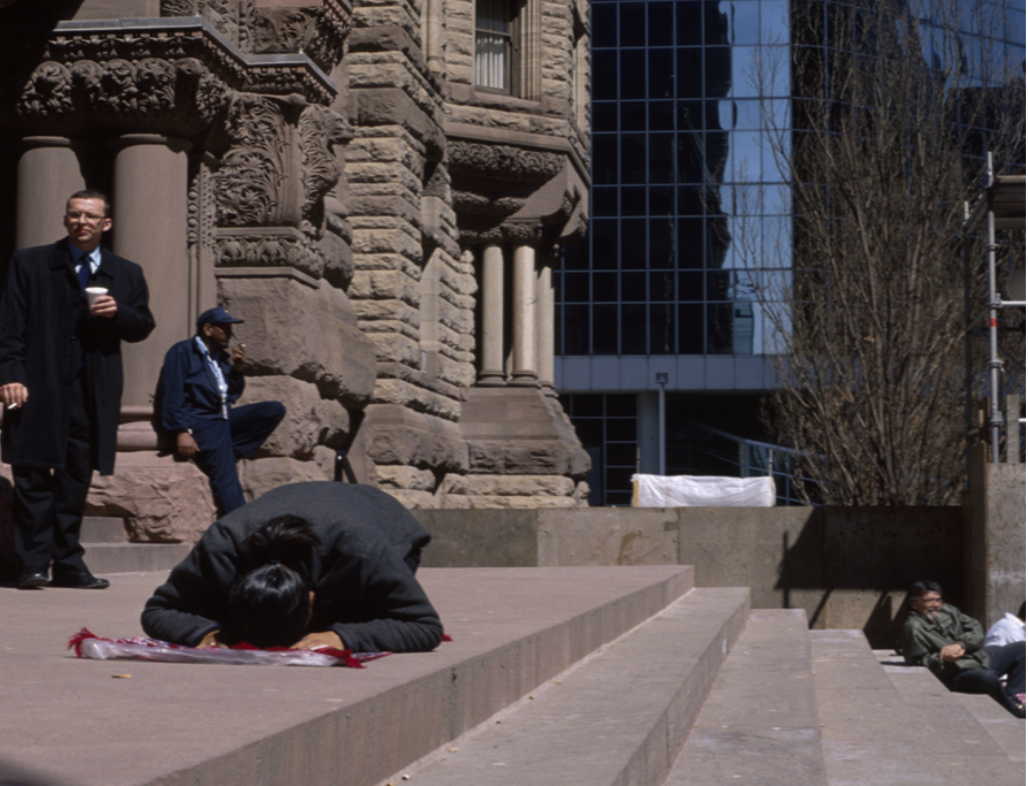
HaQ’s Retreat (2004) is a key early work for understanding how she understands prayer as a form of housekeeping. The digital photo series, displayed as color images in lightboxes, depicts a Brown Muslim woman praying on public steps and urban plazas, often on a prayer mat, surrounded by the architecture and passerby of Canadian cities. In one widely reproduced image, she kneels in prayer on the steps of Toronto’s Old City Hall, eyes closed, while pedestrians look on from the edges of the frame. The woman’s posture is one of complete attention to the divine, yet the scene announces her body as out of place within the secular civic landscape.
HaQ has described Salat, the ritual of Islamic prayer, as a form of housekeeping. She tells her children that when they perform sujud, the prostration in which the forehead touches the earth, they are “grounding” in the territory. She has called this a kind of land acknowledgment: an embodied reminder that “we are made of clay and of the earth” and that the land already holds the prayers of Indigenous peoples who have their own practices of connection to the creator. In this sense, Salat keeps the spiritual “house” of the self in alignment, but it also tends to the relationship with the ground, whose sovereignty precedes and exceeds the settler nation-state.
Indigenous and decolonial theorists have argued that genuine relation to land involves more than symbolic gestures. Simpson’s concept of “land as pedagogy” insists that land teaches through practice, through repeated acts of visiting, harvesting, listening, and narrating (Simpson 7–9). In Retreat, each prayer is one such act: a temporary reorientation of the body that interrupts the flow of urban time. The title “Retreat” complicates this reading. It suggests withdrawal from the public sphere into contemplation, yet the images insist on visibility. The praying figure does not sequester herself inside a private home or mosque. She places her mat directly on municipal steps, in front of stone and glass facades that symbolize state and corporate authority.
This is not an easily assimilated “multicultural” image of religious diversity. The kneeling body is vulnerable to surveillance and hostility. The work registers the racialized suspicion that attaches to Muslim prayer in post-9/11 North America, in which brown bodies prostrating in public are frequently framed as threats. HaQ’s quietly insistent repetition of the act across different sites echoes what Claire Bishop calls the “durational” and “participatory” qualities of much contemporary political art, in which sustained performance is used to test the social terms of public space (Bishop).
Here, the “participation” is not the audience’s but the land’s. Each prostration is a minor act of housekeeping that dusts off the relationship between body and territory. It acknowledges that the urban plaza is still Indigenous land, even as it has been paved over and repurposed. Yet, in light of Tuck and Yang’s critique, such acknowledgment cannot be confused with decolonization. It is closer to what Audra Simpson calls a “politics of refusal,” an insistence on Indigenous sovereignty and alternative political orders that exist alongside and against the state (Simpson). HaQ’s prayers refuse to naturalize the civic landscape as simply “Canadian.” They hold open the knowledge that the ground carries older, unfinished obligations.
IV. Overflowing Cups: Matrilineal Care and Colonial Bone China
If Retreat maps prayer onto public space, Drinking from my Mother’s Saucer (2015) turns to the kitchen table. The two minute video, produced in collaboration with France Trépanier, shows a close shot of chai being poured into a fragile bone china teacup.
At first it appears as a scene of comfort and hospitality. HaQ has written that one of her earliest memories is of drinking cooled chai from her mother’s saucer, curled against her body. The act is intimate, even indulgent.
Slowly, the soundscape shifts. The muted clink of ceramic is joined by the rising thunder of buffalo hooves. As the stampede grows louder, the cup begins to tremble and spill. The viewer never sees the buffalo, only hears it, as if the land’s history were pressing up through the bottom of the cup. The bone china itself becomes a charged object. HaQ notes that this particular cup was a gift from her children’s British great-grandfather and is literally made from buffalo bone. The colonial entanglement is inescapable: imported British ceramic traditions, the slaughter of buffalo as part of the colonization of the Plains, the artist’s own position as a racialized settler receiving this inheritance.
Still from Drinking from my Mother’s Saucer courtesy of Farheen HaQ
In the video, the teacup becomes a stand-in for both the personal and collective body. It contains the chai ritual passed down from HaQ’s mother, whose migration from India to Pakistan after Partition and then to Canada is part of the narrative. It also contains the land’s body, whose bones have been ground into the cup. The overflow registers a surplus that cannot be neatly held: the grief of the buffalo’s disappearance, the trauma of Partition, the ongoing dispossession of Indigenous peoples, and the artist’s own complicity.
Christina Sharpe’s concept of “the wake” is helpful here. Sharpe describes Black life as lived in the ongoing wake of slavery, where disaster is not behind us but continually structuring the present (Sharpe). HaQ’s work, while grounded in different histories, similarly insists that colonization is not a past event that can be remembered and moved beyond. The shaking teacup visualizes what it means to be in the wake of multiple, uneven catastrophes. The mother’s hand pouring chai becomes a gesture of care that is also haunted by violence.
The video also invites a reading through affect and feminist labor. Sara Ahmed has written about how certain subjects, particularly women of color, are tasked with “maintaining” the comfort of others, becoming what she calls “affect aliens” when they refuse to smooth over tension (Ahmed, The Cultural Politics of Emotion). In Drinking from my Mother’s Saucer, care does not erase tension. Instead, it lets it spill over. The sound of the buffalo does not stop the mother from pouring. She continues pouring, even as the cup trembles. The scene is not a breakdown but a recognition that care takes place in conditions that are already unstable.
The overflow suggests that no amount of tidying can contain the histories that have shaped this domestic space. HaQ’s housekeeping is not about restoring order so that nothing shows. It is about attending to what leaks out, to what cannot be fully reconciled.
V. Chains, Generations, and the Burden of Inheritance: Silsila
Silsila courtesy of Farheen HaQ
HaQ extends these questions of maternal care and inheritance in works like Silsila, which foregrounds the chain that links grandmothers, mother, and daughter. While information about this specific work circulates more fragmentarily than about Retreat or Drinking from my Mother’s Saucer, it is consistently described as exploring lineage and the provision of care across generations. The title itself means “chain” or “sequence” in several South Asian and Arabic languages, and in Sufi contexts it can refer to a spiritual lineage.
In Silsila, the chain is not purely metaphoric. It names the way knowledge, trauma, and ritual practices move between bodies over time. The piece figures mother, daughter, and grandmother as links who provide for one another, carrying forward both burden and blessing. The work therefore resonates with Leanne Betasamosake Simpson’s insistence that resurgence requires generations to grow up “intimately and strongly connected” to their homelands and traditions, even when those homelands have been violently transformed (Simpson 2–3).
In immigrant and diasporic households, such chains are often strained. Children may feel caught between ancestral rituals and the demands of assimilation. Mothers may carry unprocessed trauma from their own migrations. Grandmothers may cling to a cleaning ethic that was tied to survival in contexts of scarcity and instability. Silsila recognizes that inheritance is not only cultural richness but also an obligation. The knowledge of how to pray, serve chai, and care for elders is transmitted alongside the knowledge of dispossession, racism, and colonial violence.
HaQ does not represent this inheritance as purely sentimental. The chain can weigh heavily. Yet it is also the mechanism through which reconciliation becomes imaginable. The artist’s housekeeping is not an individual practice. It is shaped by what she has received and what she passes on. In this, it resembles the notion of “grounded normativity” articulated by Glen Coulthard and others: an ethic that arises from specific relationships to land and community, rather than from abstract principles.
Silsila thus sits at the center of HaQ’s project. It reminds us that every act of cleaning, praying, or tending to home is also a conversation with those who came before and those who will come after. The chain is not broken by grief or trauma, but it is altered by how each generation chooses to keep house.
VI. Laying Stories on the Land: The Ground Above Us
If housekeeping begins with the home, HaQ’s collaboration The Ground Above Us (2019) with Charles Campbell and Yuxwelupton Qwal’qaxala (Bradley Dick) shows how it extends beyond it. The project, exhibited at UVic Legacy Gallery in Victoria, takes place on Lekwungen territory and centers on the question: what does it mean for racialized artists to work on this ground as guests and uninvited settlers?
The installation combines materials such as copper, monofilament, and Lekwungen fishing weights with community gatherings, shoreline walks, and conversations.The artists invite participants to sit by the sea, handle stones, and share stories in pairs while asking each other how they might come into better relation with the land. HaQ has described the work as an effort to “lay stories on the land,” to acknowledge that their voices and practices are always already entangled with Indigenous histories and ongoing sovereignties.
In the context of this essay, The Ground Above Us extends housekeeping into a collective practice of outdoor cleaning, not of surfaces but of relationships. The title suggests a reversal. Usually we think of the ground as beneath us. Here, the artists draw attention to the sedimented histories that hover over the present. The ground is “above” in the sense that its obligations exceed the artists’ current capacity to repay. They cannot restore what has been taken. They can only sit with the discomfort of that imbalance and cultivate practices of gratitude and listening.
Tuck and Yang’s argument that decolonization is not a metaphor is once again crucial. The work does not claim that walking on the shore, sharing food, and telling stories decolonizes the land. Instead, it treats these actions as forms of spiritual and ethical housekeeping that might make it harder for participants to forget the land’s demands.
Audra Simpson’s theorization of refusal also resonates. In Mohawk Interruptus, she describes refusal as a stance that declines to let the settler state set the terms of recognition and belonging (Simpson). The Ground Above Us refuses to narrate reconciliation as a completed event. Instead, it lingers in process, in “the effort we are making to find our place on this land,” as HaQ and Campbell put it.
This effort is slow and repetitive, like the tasks of laundry or dishwashing. It must be returned to again and again. The artists’ choice to structure the project over a year, with multiple gatherings and meditations, underscores this temporal dimension. There is no single cathartic moment. There is only the ongoing work of keeping relations in motion.
VII. Wash and Fold: Housekeeping in a Time of Pandemic and Racial Justice
HaQ’s recent work Wash and Fold: Revelatory Housekeeping in an Age of Pandemic and Racial Justice brings many of these threads together. The current iteration of the video shows the artist and her daughter moving through a series of cleaning and tidying actions, folding laundry, wiping surfaces, and navigating the cramped spaces of the family home. Overlaid is HaQ’s voice, stitched from conversations that circle around the murder of George Floyd, the grief of leaving and returning home, and the necessity of gratitude.
The work is set in the context of COVID-19 lockdowns, when many people were confined to their homes and domestic labor intensified. For racialized families, this period also overlapped with renewed visibility of anti-Black police violence and public demands for structural change. Wash and Fold registers this convergence. The house becomes a site where global crises are felt not as abstract news items but as pressure on the nervous system. The laundry basket is never empty. The newsfeed is never still.
Sara Ahmed’s writing on the feminist killjoy is instructive here. Ahmed notes that women of color are often cast as “spoiling the mood” when they name racism or injustice in contexts where others want to maintain harmony (Ahmed, The Promise of Happiness). In Wash and Fold, HaQ refuses the demand to keep home as a bubble of pure comfort. Her narration refuses to separate the joy of sharing space with her daughter from the sorrow of racial violence and the claustrophobia of lockdown. Housekeeping becomes a revelatory practice because it makes visible the contradictions that more glamorous forms of art might bracket off.
At the same time, the work is tender. The gestures of folding and washing are not only burdens. They are also ways of sustaining life and intimacy. The title’s phrase “revelatory housekeeping” suggests that revelation does not arrive through grand epiphanies but through repetitive, accessible acts. Revelation is recognizing that care is both exhausting and sustaining, that gratitude can coexist with rage, and that the house is at once a refuge and a reminder of the broader structures that restrict movement and safety.
Here, HaQ’s practice intersects obliquely with the participatory and socially engaged art histories that Claire Bishop has mapped. Bishop is critical of celebratory accounts of participation that equate any collaborative project with emancipation (Bishop). HaQ’s work operates at a different scale but shares this skepticism. Her collaborations with family and community do not claim to resolve inequality. They hold the difficulty of relation in place. In Wash and Fold, the “participants” are her own child and the viewer, who is invited to sit with the discomfort of watching someone else’s domestic labor without intervening.
When HaQ asks how we “situate housekeeping in a time when we are trapped in our houses,” she echoes the moment when I recognized my grandmother’s grief in the scattered objects around her home. Both scenes suggest that the house can be both container and mirror. It holds the residue of pain that cannot be spoken directly. It reflects the limits of one’s capacity to care. HaQ’s decision to film these processes is itself an act of keeping house, not in order to erase the mess, but to attend to it.
VIII. The Cure for Pain Is in the Pain
Each time I return to a work by HaQ, I think of my grandmother. I find myself pointing to the trauma, grief, and ache that seep through the images and sounds. Each time, HaQ responds by citing a verse from Rumi: “The cure for pain is in the pain.” The line does not romanticize suffering. Instead, it proposes that the only way through is a deeper, more honest engagement with what hurts.
Housekeeping, in this essay, has emerged as such an engagement. It is the work of returning to the same floor, the same dishes, the same laundry, the same prayer rug, not because one believes that these tasks will fix the world, but because they keep relation alive. In a settler colonial context, this means maintaining an active consciousness of the land beneath the house and of the Indigenous sovereignties that persist despite occupation. It also means acknowledging one’s own complicity and benefiting, as a racialized settler, from structures that harm others.
Farheen HaQ’s practice offers a vocabulary for such a method. Through Retreat, she casts Salat as both spiritual discipline and embodied land acknowledgment, a way of grounding on territory that is not hers while honoring those whose it is. Through Drinking from my Mother’s Saucer, she brings matrilineal care and colonial violence into the same frame, letting the teacup overflow rather than pretending that these histories can be neatly contained. Silsila names the chains that link generations, insisting that inheritance includes both trauma and ritual. The Ground Above Us extends housekeeping to the shoreline, where stories are laid on the land in collective attempts to listen more carefully. Wash and Fold returns to the cramped interior during the pandemic, revealing how racial justice struggles echo in the most mundane motions of laundry and cleaning.
Across these works, housekeeping becomes a method for reconciliation understood not as a completed state but as an ongoing, asymmetric process. It is reconciliation that refuses the easy metaphors Tuck and Yang warn against, that does not substitute symbolic apologies or cultural recognition for the material repatriation of land and life. Instead, it asks what small, daily acts might keep us from forgetting what we owe.
If the house is a reflection of the soul, then the soul must be understood as a complex, historically saturated terrain, marked by migration, privilege, and loss. To keep house is not to polish that terrain until it shines without blemish. It is to attend to the dust and the cracks, to the shaking of the cup, to the unevenness of the ground above and below us. It is to watch the dust settle and, every single time, choose to get up and take care of it some more.
-
Works Cited
Ahmed, Sara. The Cultural Politics of Emotion. Routledge, 2004.
Ahmed, Sara. Living a Feminist Life. Duke University Press, 2017.Bishop, Claire. Artificial Hells: Participatory Art and the Politics of Spectatorship. Verso, 2012.
Hartman, Saidiya. Lose Your Mother: A Journey Along the Atlantic Slave Route. Farrar, Straus and Giroux, 2007.
HaQ, Farheen. “Drinking from my mother’s saucer.” Farheen HaQ, 2015, www.farheenhaq.com. Accessed 17 Nov. 2025.
“I am my mother’s daughter.” Rungh Magazine, 2023, rungh.org/i-am-my-mothers-daughter/. Accessed 17 Nov. 2025.
Sharpe, Christina. In the Wake: On Blackness and Being. Duke University Press, 2016.
Simpson, Audra. Mohawk Interruptus: Political Life Across the Borders of Settler States. Duke University Press, 2014.
Simpson, Leanne Betasamosake. “Land as Pedagogy: Nishnaabeg Intelligence and Rebellious Transformation.” Decolonization: Indigeneity, Education & Society, vol. 3, no. 3, 2014, pp. 1–25.
Tuck, Eve, and K. Wayne Yang. “Decolonization is Not a Metaphor.” Decolonization: Indigeneity, Education & Society, vol. 1, no. 1, 2012, pp. 1–40.
“A Practice of Gesture.” Galleries West, 4 Oct. 2021, www.gallerieswest.ca/magazine/stories/a-practice-of-gesture/. Accessed 17 Nov. 2025.